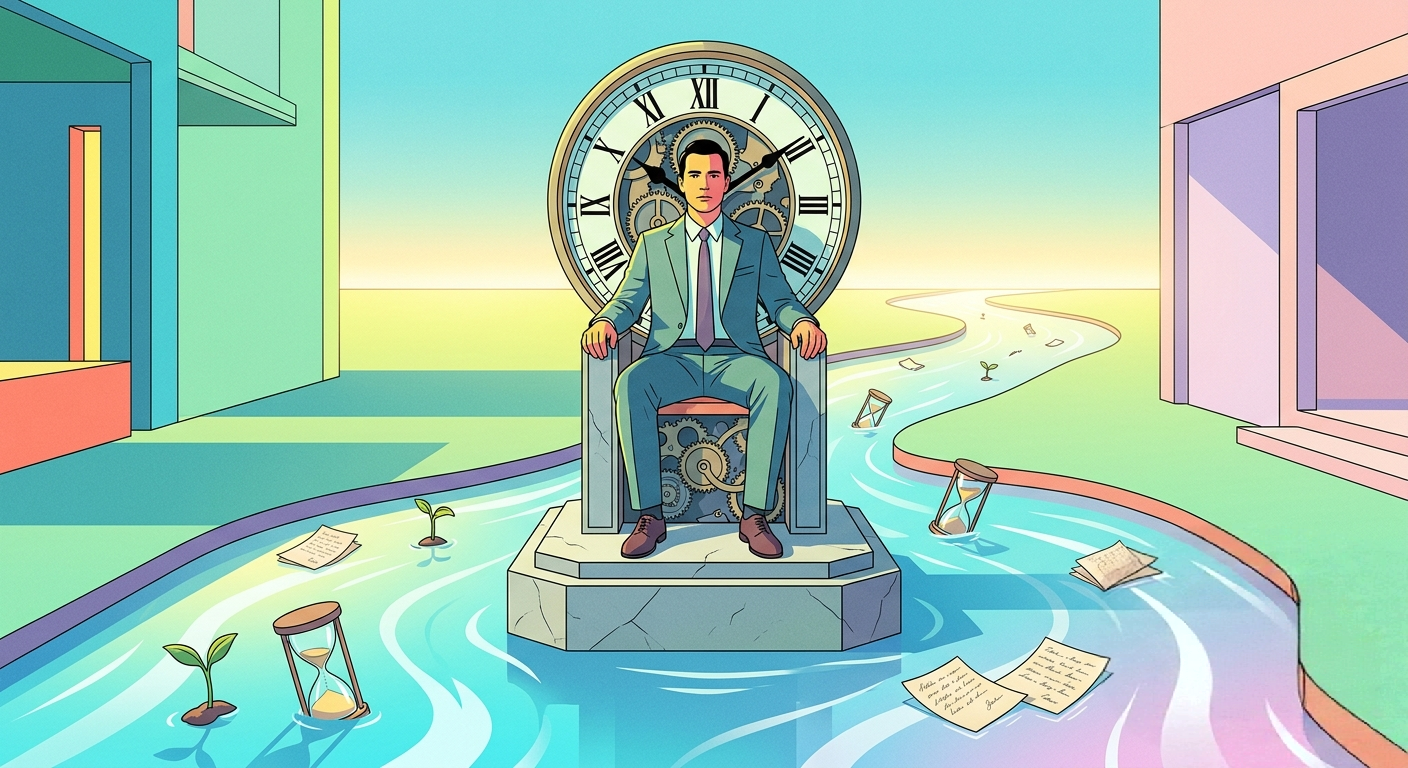
Time is such an elusive thing. It is everywhere, yet nowhere.
We cannot see it, touch it, hold it in our hands, or place it on a table and examine it. Yet, nothing escapes its influence. Its presence is revealed not by what it is, but by what it does.
Plant a seed in the soil and water it faithfully. You may see little happening at first. But leave it there, and time begins its quiet work. Beneath the soil, something stirs. Roots emerge. A stem pushes upward. Leaves unfold. Eventually, what was once a tiny seed becomes a beautiful plant.
Time did not attempt to make a spectacle of the transformation. It simply worked. It just continued.
The same is true of human beings.
A child enters the world small, fragile, curious, and almost entirely dependent on others. Then time begins its work. The body stretches. Bones strengthen. The brain develops. Experiences accumulate. Words become language. Language becomes thought. Thought becomes understanding. The helpless child gradually becomes a person capable of making choices, forming beliefs, creating things, loving, destroying, building, learning, and dreaming.
Time changes everything it touches. It teaches, it builds, it erodes, heals, it wounds, it reveals.
And sometimes, it takes away.
Without time, there is no growth, as growth itself is a process unfolding through time. There is no learning, because learning requires experience. There is no adaptation, because adaptation requires a change. There is no becoming, because becoming is the journey from what something was to what it becomes.
In that sense, time is the great agent of transformation.
Yet, there is something cruel about it.
Time does not care. You cannot plead with it. You cannot bargain with it. You cannot command it to slow down because you are not ready. You cannot ask it to return because you finally understand what you should have done. You cannot offer it money, tears, promises, or apologies in exchange for what has already passed.
It just moves. When you are happy, when you are grieving, when you are prepared and when you are completely unprepared.
It moves while you are building your dreams, and it moves while you are procrastinating.
It moves while you are paying attention, and it moves while you are distracted.
It moves when you're fulfilling purpose, and it moves, when you're endlessly figuring it all out.
And perhaps most unsettling of all, it moves whether you acknowledge it or not.
And one day, you wake up and realise that something you thought happened recently happened years ago. A childhood memory becomes decades old. A dream you once promised yourself you would pursue remains untouched. Someone you thought would always be around is suddenly gone.
Then you find yourself asking a question that cannot be answered:
Where did all that time go?
And the tragedy of time is that it does not return what it consumes.
Past time can simply not be recovered.
The hour you spent scrolling, the afternoon you spent postponing, the years you spent living according to another person's expectations, all of them have become part of a past that cannot be edited.
And the greater tragedy is, when we then waste the present mourning the past, regretting the time we lost, and in doing so, we lose even more time.
This leads us then, to the concept of Time Sovereignty.
Time Sovereignty
Time sovereignty does not mean ruling over time, or bending time, as no human possesses such power.
Time Sovereignty is sovereignty over your relationship with time. It is the decision to become a deliberate steward of the minutes, hours, days, weeks, months, and years that have been entrusted to you.
It is recognising that while you cannot control the passage of time, you can influence where your time goes.
You can influence if it goes toward your work, your relationships and networks, your ambitions, your body, your mind, your faith, your entertainment, your fears, your distractions, your responsibilities, your dreams, your purpose.
And every day, whether consciously or unconsciously, you allocate portions of your finite existence. Time sovereignty is having deliberate and intentional control over these allocations.
The world constantly competes for your time.
Social media wants your attention. Businesses want your money and attention. Employers want your labour. People want your availability. Friends want your comfort. Entertainment wants your evenings. Society wants you to pursue certain definitions of success. And God, wants your everything.
And increasingly, algorithms are becoming extraordinarily good at predicting what will keep you looking, scrolling, clicking, and consuming.
You can spend hours watching other people's lives while neglecting your own. You can become so entertained that you never become. You can become so available to everyone else that you become absent from your own life.
Sovereignty is realising that not every message requires an immediate response, not every opportunity deserves a yes, not every trend deserves your attention, not every invitation deserves your presence, not every desire deserves your obedience. Every minute needs to be productive and intentional, but not by conventional definition.
Rest can be intentional, and productive. Play, silence, and doing absolutely nothing for a while, can be productive, and intentional.
The goal isn't to transform your life into tasks on a checklist, but to live consciously enough that every bit of your time is being spent according to your values, rather than merely according to whatever happens to demand your attention.
So that, at the end of our days, whether near or far, we can look back, without regret, and say, 'it was a life well spent.'


Discussion
0 comments